Quick answer: Standard flat-fit bands 6mm and wider typically need about half a size larger than your usual ring size. Comfort-fit bands don’t need an adjustment until they reach roughly 8mm, where a quarter size up is common.
Ring & Wedding Band Width Guide: What Each Width Looks Like
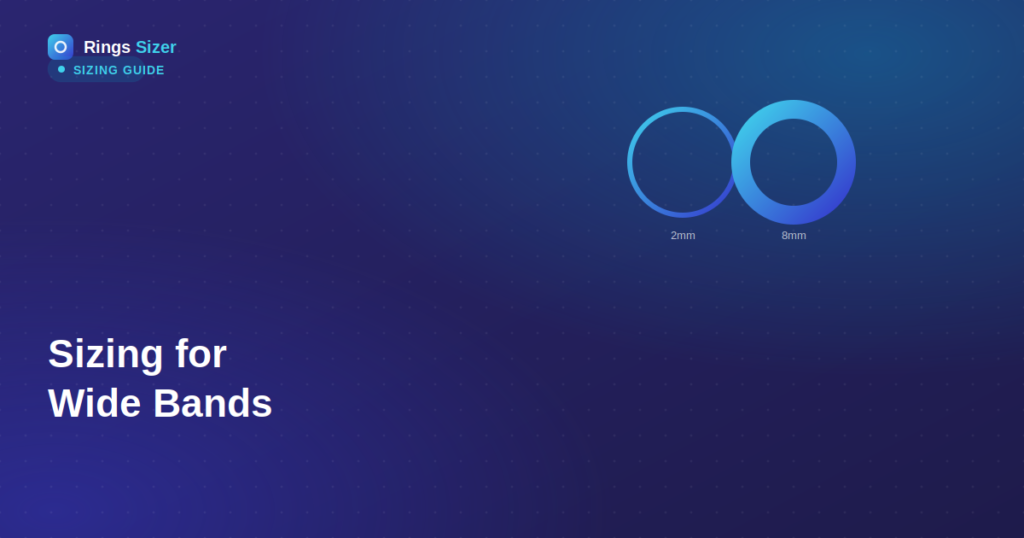
Before getting into sizing math, it helps to see the actual scale — band width is usually described in millimeters, and the difference between a 2mm and an 8mm band is bigger than most people picture. Here’s what the common widths mean in practice:
| Width | Typical Use |
| 2mm | Thin stacking rings, delicate fashion bands |
| 4mm | Classic slim wedding bands, engagement ring bands |
| 6mm | One of the most popular wedding band widths |
| 8mm+ | Bold statement rings, wide comfort-fit bands |
Note: on the live site, this table is shown as a scaled visual bar chart rather than a plain table — the information is the same, but Gutenberg’s Table block is the closest equivalent for a pasted layout.
Why Wide Bands Fit Differently
Your ring size is based on the circumference at a single point around your finger — but a wide band doesn’t just sit at that point, it also covers more of your finger above and below your knuckle, where the finger tapers. A thin band only needs to clear the narrowest part; a wide band has to clear a slightly larger area, which is why a “true to size” thin band and a wide band at the exact same labeled size can feel noticeably different.
How Much to Size Up, by Width and Fit Type
- 2–4mm, standard or comfort fit: No adjustment needed — fits true to size.
- 6mm, standard flat fit: Size up about half a size.
- 6mm, comfort fit: Usually no adjustment needed.
- 8mm and wider, standard flat fit: Size up about half a size.
- 8mm and wider, comfort fit: Size up about a quarter size.
Comfort Fit vs. Standard Fit
A comfort-fit band has a slightly domed or rounded interior, rather than a flat one. That curved profile means less metal actually contacts your finger at any given cross-section, so the ring slides on and off more easily and generally needs less of a size-up adjustment at a given width than a standard flat-fit band of the same width.
Tips for Choosing a Wide Band
- If you’re between sizes already, lean toward the larger size when choosing a wide band — it’s more forgiving than going tight.
- Try on the actual width you’re planning to buy where possible, rather than relying on your normal ring size alone.
- Consider comfort fit for anything 6mm or wider if you haven’t worn a wide band before — it’s a meaningfully different feel than a thin band.
Frequently Asked Questions
What is a standard ring or wedding band width?
There’s no single standard — 4mm is common for slim wedding bands and engagement ring bands, while 6mm is one of the most popular overall wedding band widths, especially for men. Anything 8mm and up is generally considered a wide or statement band.
Do I need to size up for every wide band?
Only if it’s a standard flat-fit band. Comfort-fit bands with a domed inner edge typically don’t need any adjustment until they get quite wide, since the rounded interior takes up less room across the knuckle.
How much should I size up for an 8mm band?
For a standard flat-fit 8mm band, sizing up about half a size from your normal ring size is a common starting point. For a comfort-fit 8mm band, a quarter size is often enough.