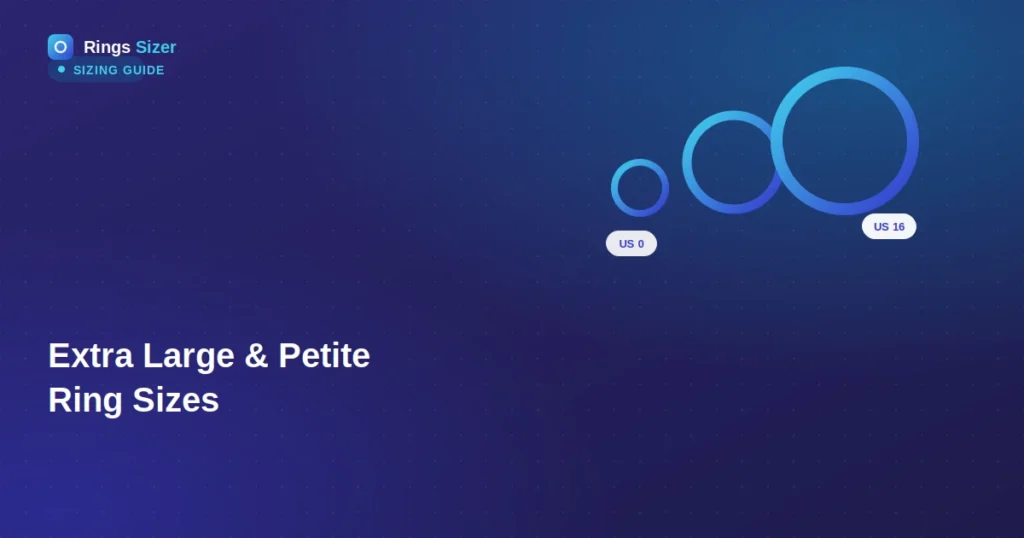
Quick answer: Standard adult ring charts usually stop at US 3 to 13, but real sizes exist well outside that range — down to about US 0 for very slender or younger fingers, and up past US 16 for larger hands. Extended sizes are genuine, but less standardized between jewelers than the common range, and often require a special or custom order rather than an off-the-shelf ring.
Why Most Charts Stop at US 3–13
The 3-to-13 range covers the large majority of adult finger sizes, so it’s what most retailers stock as standard and what most published charts show — including the main chart on this site. But “most people” isn’t “everyone,” and plenty of real hands fall outside that window on either end.
Petite Sizes: Below US 3
Sizes below US 3 exist and are genuinely used, particularly for very slender fingers, some petite adults, and as a bridge between children’s and standard adult sizing.
| US Size | Inside Diameter | Inside Circumference |
| 0 | 11.6 mm | 36.5 mm |
| 0.5 | 12.0 mm | 37.8 mm |
| 1 | 12.4 mm | 39.0 mm |
| 1.5 | 12.8 mm | 40.3 mm |
| 2 | 13.2 mm | 41.6 mm |
| 2.5 | 13.6 mm | 42.9 mm |
This continues directly from where our standard US chart begins at size 3, using the same inside diameter and circumference measurements, just extended downward.
Extra Large Sizes: Above US 13
Sizes above US 13 are also real and used, though they become progressively less standardized the larger they go — different suppliers’ extended charts start to diverge slightly from each other at this end, more than they do within the common 3–13 range. Treat the figures below as a close approximation rather than an exact universal standard.
| US Size | Approx. Inside Diameter | Approx. Inside Circumference |
| 13.5 | ≈22.4 mm | ≈71 mm |
| 14 | ≈23.0 mm | ≈72 mm |
| 14.5 | ≈23.4 mm | ≈74 mm |
| 15 | ≈23.8 mm | ≈75 mm |
| 15.5 | ≈24.2 mm | ≈76 mm |
| 16 | ≈24.6 mm | ≈77 mm |
Why Extended Sizes Are Less Standardized
Within the common range, ISO 8653:2016 and equivalent national standards keep most jewelers’ charts closely aligned. Outside that range, fewer rings are mass-produced at those sizes, so less of the market has converged on identical reference points — one supplier’s “size 15” chart may differ by a millimeter or so from another’s. That’s normal at the extremes and not a sign either chart is wrong.
What to Do If You’re Outside the Standard Range
- Measure carefully using the string, paper, or existing-ring method — precision matters more here since there’s less room for a chart to smooth over small differences.
- Expect to special-order or work with a jeweler directly for many styles, since extended sizes are stocked far less often than the standard range.
- Custom sizing or made-to-order pieces are common solutions at either extreme — a jeweler can typically produce a ring at almost any real size, even if it isn’t sitting on a shelf.
Whatever size you land on, our converter and measuring guide work the same way regardless of where you fall on the scale — the underlying measurement (inside circumference) doesn’t stop being useful just because it’s outside the common range.
Frequently Asked Questions
Is there a smallest possible ring size?
Practically, sizes around US 0 (roughly 36.5mm circumference) are about as small as most jewelers will go for a standard ring, though true custom pieces can technically go smaller.
How large can ring sizes go?
Many jewelers offer extended sizing up to around US 16 or beyond on request, though very large sizes almost always require a special order rather than an in-stock ring.
Are extended sizes accurate the same way standard sizes are?
The underlying measurement principle is identical, but published charts for extended sizes vary a bit more between suppliers than the standard 3–13 range does, simply because fewer rings are made at those sizes and less of the market has converged on identical reference points.